

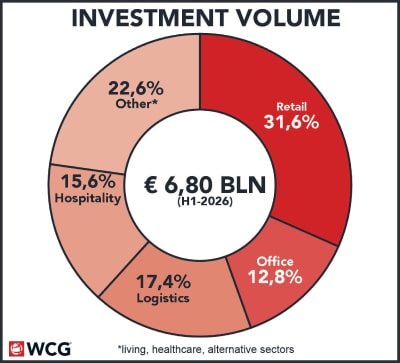
The first half of 2026 confirms the attractiveness of Italian commercial real estate on a global level, recording an investment volume of approximately 6,8 billion euros.
Historically characterized by slow cycles, the real estate sector has now entered a phase of continuous transformation. Despite the persistent climate of international geopolitical instability, Italy continues to confirm its appeal, attracting investment and, thanks also to a favorable tax environment, proving increasingly attractive to high-spending segments of the population.
Compared to the first half of 2025, the market recorded a growth of 30% , while Q2 2026 marked an increase of approximately 80% compared to Q2 2025.
Retail: investments growing strongly
The major transaction at Via Montenapoleone 8 , along with other significant retail park transactions, has once again boosted this asset class. The retail segment is expected to exceed €2 billion in investments in the first half of 2026, with second-quarter performance more than doubling compared to the first.
Today, retail represents approximately 32% of total commercial real estate investments, confirming the trend of recent years and the centrality of assets oriented towards the consumer experience.
Other: confirms its appeal
The Other segment confirmed its appeal, attracting over 22% of investments in H1 2026 and reaching more than €1,5 billion . The second quarter also saw particularly significant results, with approximately €950 million invested, driven primarily by the Living sector, which exceeded €700 million in the first half of the year. Compared to H1 2025, the segment recorded 36% growth.
Logistics: Accelerate the transformation
In the first half of 2026, logistics saw a 30% increase compared to the same period last year, reaching nearly €1,2 billion in investments. The ongoing transformation is driving many logistics operators to rethink their supply chains, with a growing demand for high-quality space in strategic locations. These properties must not only meet new distribution needs but also support specialized and innovative activities, requiring increasingly targeted skills and a highly qualified workforce, whose average age is now over 40.
Hospitality: confirmed attractiveness
The hospitality sector remains a highly attractive segment of the Italian market, with investment recovering 12% compared to Q1 2026.
Despite strong demand, Italy continues to suffer from some structural challenges related to the characteristics of its real estate portfolio. During the first half of the year, the sector exceeded €1 billion in investments, representing over 15% of the total.
Office: The recovery continues
The Office sector continues its recovery path, recording growth of 10% compared to H1 2025 and 55% compared to Q1 2026.
With over 800 million euros raised, equal to almost 13% of total investments, the sector confirms its evolution.
The demand for high-quality properties – energy efficient and capable of meeting the new needs of occupiers – is growing. The average size of the spaces required is decreasing, while the number of letting transactions is increasing. At the same time, rents rents in the squares of Milano and Rome continue to grow and the outlook indicates a further consolidation of this trend.
Overall, the first half of 2026 confirms the strength of the Italian commercial real estate market, supported by growing investor confidence, who are increasingly attentive and selective. Despite an international context still characterized by high geopolitical and economic volatility, Italy demonstrates an ability to attract capital across the main asset classes, capable of satisfying the aforementioned targeted demand. These are real estate products that enjoy constant and solid demand, supported by the real economy, and capable of guaranteeing cash flows over time. In the Italian market, logistics will continue to maintain its strategic role, as will hospitality, driven by increasingly advanced and growing demand in our country. Furthermore, let's not forget the importance of living, as many of the current legal situations are resolved, and the increasingly debated topic of data centers. In this rapidly and continuously evolving market, it is essential to understand the current and future needs of the target end-users. Innovation and sustainability must be viewed and interpreted through their respective perspectives. view, to then be translated into design and management choices capable of improving the quality of spaces and their use - he has declared Marco Clerici, Head of Advisory & Research at WCG Therefore, in this scenario characterized by high uncertainty, we expect substantial stability in investments in the second half of the year, albeit with all necessary precautions.”